
Work With a CRO Recruiter
RevPilots helps companies hire Chief Revenue Officers who are the right fit for their stage, their motion, and their board.
Our CRO recruiters specialize in executive revenue leadership hiring and move fast without cutting corners. Most CRO searches surface a qualified shortlist within two to three weeks — significantly faster than a traditional retained executive search.
What Is a CRO and When Do You Need One?
A Chief Revenue Officer owns the full revenue function — not just sales, but marketing, customer success, and sometimes partnerships and RevOps as well. The CRO is accountable for how revenue is generated, retained, and grown across the entire customer lifecycle.
That scope is what distinguishes the role from a VP of Sales. A VP of Sales owns new logo acquisition and the sales team that drives it. A CRO owns everything that touches revenue: how the pipeline gets built, how deals get closed, how customers are retained, and how they expand. In practice, a CRO is often the person who makes the VP of Sales, the VP of Marketing, and the VP of Customer Success work as one system rather than three separate departments pointing fingers at each other.
Not every company needs a CRO. Early-stage companies that haven’t found a repeatable go-to-market fit usually need a VP of Sales first — someone who can build and run the sales function before a CRO takes ownership of the broader revenue organization. The CRO hire typically makes sense when a company has meaningful ARR, a growing customer base worth protecting, and a need to align multiple revenue-adjacent functions under a single leader who reports directly to the CEO.
Getting that timing wrong in either direction is expensive. Hire a CRO too early, and you’re paying executive-level comp for a role that doesn’t have enough scope yet. Hire too late, and you’re leaving misalignment between sales, marketing, and CS to compound for longer than it should. We help companies figure out which hire they actually need before we start a search.
CRO vs. VP of Sales — What’s Actually Different
The distinction matters because the screening criteria are genuinely different. Companies that treat a CRO search like a senior VP of Sales search end up with the wrong hire.
A VP of Sales is primarily a sales leader. They own quota, manage AEs, run pipeline reviews, forecast, and build the team that closes new business. They may influence marketing or CS, but they don’t own those functions.
A CRO is a revenue systems leader. They’re accountable for the entire arc from demand generation through expansion — which means they need to understand how marketing creates pipeline, how CS retains and grows accounts, and how all of it connects to the ARR number the board cares about. They also typically sit closer to the CEO and board, which requires different communication skills and strategic fluency than a VP of Sales role demands.
The other difference is organizational authority. A CRO who doesn’t have genuine authority over the functions they’re supposed to align will fail, not because they’re the wrong person, but because the structure made the job impossible. Before we start a CRO search, we make sure the role is scoped in a way that gives the candidate a real chance to succeed.
Where the line blurs: some companies use the CRO title for what is functionally a VP of Sales role — single function, no CS or marketing ownership, similar compensation. That’s fine if it helps with recruiting, but it changes the candidate profile significantly. We’ll help you figure out which you actually need.
What We Look For in a CRO
CRO candidates are senior, polished, and very good at interviewing. Our job is to evaluate the substance behind the presentation.
We look at the full revenue motion they’ve owned. Not just sales — what was their actual relationship with marketing? Did they have authority over CS, or just influence? How did they handle misalignment between sales and marketing when the SDR team was blaming lead quality and marketing was blaming follow-up? These are the questions that reveal whether someone has actually run a revenue organization or just sat near the top of one.
We look at the ARR trajectory under their leadership. Not just whether the number went up — markets go up, products improve, sales cycles shorten. We want to understand what the candidate specifically did to drive growth, and whether they can point to before-and-after data that holds up to scrutiny.
We look at net revenue retention. CROs who only care about new logos and leave retention to CS without engagement are running a leaky bucket. The best CROs think about NRR as seriously as new ARR, because they understand that expansion from existing customers is almost always more capital-efficient than new logo acquisition.
We look at board and CEO relationships. A CRO who can’t communicate clearly with investors, translate revenue data into a business narrative, or push back on unrealistic targets without burning the relationship is going to have a short tenure. We ask candidates to walk us through a specific situation where they disagreed with the board or CEO and how they handled it.
We look at the teams they’ve built. How did they hire? How did they develop people? How many people have they managed who have gone on to VP and CRO roles themselves? A CRO who produces leaders is compounding value. One who produces dependency is a retention risk.
We verify everything. Senior candidates have long careers with complex narratives. We cross-reference what we hear with what we know about the companies they’ve worked for, and we ask follow-up questions until the picture is complete.
CRO Compensation Benchmarks
CRO compensation is among the most variable in the C-suite. The median SaaS CRO base salary is $165,000, with a typical range of $100,000–$225,000. Total on-target earnings typically reach 1.8–2.5x base salary, making CRO one of the highest-earning executive roles in SaaS.
CRO variable pay is typically 45–60% of OTE, tied to company-level revenue targets rather than individual deal quotas. Common metrics include ARR growth, net revenue retention, and gross margin. Accelerators for exceeding targets can push variable pay to 150–200% of the target, making total compensation highly leveraged.
| Company Stage | Base Salary | OTE | Equity |
|---|---|---|---|
| Seed / Pre-Series A | $120K – $160K | $180K – $280K | 1.0% – 2.5% |
| Series A | $150K – $200K | $250K – $380K | 0.75% – 1.5% |
| Series B | $185K – $230K | $320K – $480K | 0.5% – 1.0% |
| Series C+ | $220K – $280K | $400K – $600K+ | 0.25% – 0.5% |
| Late Stage / Pre-IPO | $250K – $350K+ | $500K – $800K+ | RSUs / performance-based refreshes |
Series A–B CROs earn lower base but carry larger equity stakes of 1.0–1.5%. Series C+ CROs command $250K–$350K+ base with OTE often exceeding $500K. The role is most common at companies with $10M+ ARR.
A few things that move candidates within these ranges: scope of ownership (sales only vs. sales plus CS plus marketing), whether the company is growing fast enough to make variable pay realistic, the quality of the equity story, and whether the candidate has competing offers. We help you think through package structure before you make an offer — not after you’ve already lost a candidate over it.
One structural note: double OTE is standard for CRO packages, meaning a CRO earning $250,000 base could earn up to $500,000 in total annual compensation through performance-based bonuses and equity. Candidates who’ve held the role before will benchmark against this. If your package doesn’t reflect the scope of what you’re asking the person to own, the best candidates will notice.
How Stage Affects the CRO Hire
The CRO who works at $5M ARR is a different profile from the one who works at $50M ARR. Stage fit is as important as skill fit, and getting it wrong is expensive.
- $1M – $10M ARR: At this stage, most companies don’t need a CRO yet — they need a VP of Sales who can build the sales function and establish a repeatable motion. If you’re bringing in a CRO this early, you need someone genuinely comfortable building from scratch, probably with founder-level hustle, and willing to be hands-on in ways that more senior CROs won’t accept. The equity needs to reflect that ask.
- $10M – $30M ARR: This is where CRO searches typically begin to make sense. The company has a product that sells, a growing customer base, and enough complexity across sales, CS, and marketing that alignment has become a real problem. The right CRO at this stage has operated in a similar ARR range before — they’ve been through the process of professionalizing a revenue organization without the benefit of a large team and unlimited resources.
- $30M – $100M ARR: The motion is established, but scaling it requires real organizational management ability. The CRO at this stage is often dealing with their first enterprise motion, their first international market, or their first serious churn problem. They need to have handled at least one of those before.
- $100M ARR and beyond: The search becomes harder and the pool smaller. Candidates who’ve operated at this scale are rare and usually have multiple conversations happening at once. Compensation expectations are at the top of the ranges above, and equity is increasingly RSU-based rather than options. These searches run retained and take longer than earlier-stage searches.
The RevPilots CRO Search Process
CRO searches run differently from AE or VP of Sales searches. The candidate pool is smaller, most of the best candidates are passive, and the vetting required is more involved. We treat them accordingly.
All CRO searches run on a retained basis. That gives us the ability to dedicate the time and focus the role requires — including direct outreach to passive candidates who aren’t responding to job postings, which is where most strong CRO candidates live.
RevPilots typically deliver a shortlist of three to five qualified candidates within five days. That’s faster than most traditional executive search firms because we specialize in revenue leadership and already have relationships in the space. We don’t start building a network when you work with us — we bring one.
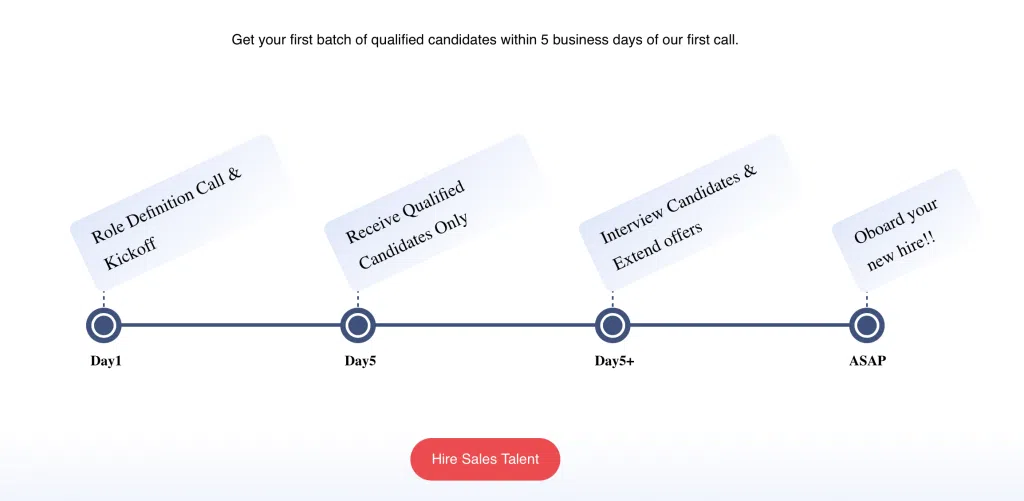
We stay involved through the offer stage and beyond. CRO candidates often have competing offers. Counter-offers from current employers are common. Package structure matters as much as the number, and we help you navigate both. A candidate who makes it to the offer stage and then walks away because the equity story wasn’t told clearly is a failure we take seriously.
What Our Clients Say
We’ve helped other clients with our chief revenue officer (CRO) recruiters:
“RevPilots did a great job with a very challenging search. We immediately recommended them to our investors for other portfolio companies. They gave us so many good candidates.” – Brent Dorfman, CEO – DriverReach
“Working with RevPilots has been a game-changer for our business. Their team understood our needs and delivered top-notch candidates across various positions, who have already started making a significant impact. The entire process was smooth and efficient, and we couldn’t be happier with the results.” -Eric Brown, COO – LeadCoverage
“RevPilots has been a key partner for filling our sales org with great talent. They helped us with multiple Account Executive roles and our VP of Sales. They did it in record time, beating out a much larger recruiting firm that they were competing with.” -Gabe Bensimon, Principal – Seroda Equity Partners
Why RevPilots for a CRO Search
Most executive search firms place across every function. We only work in revenue leadership. Our recruiters understand the difference between a CRO who’s built a revenue organization and one who’s managed a sales team with a broader title. They know what stage fit looks like at different ARR milestones, what board-level communication ability actually requires, and how to evaluate go-to-market judgment rather than just quota history.
We’ve placed revenue leaders across SaaS, fintech, cybersecurity, healthcare technology, and other complex B2B categories. We know where the best candidates are, what it takes to get them on the phone, and how to close the ones you want.
Frequently Asked Questions about a CRO Recruiter
Related Resources
- VP of Sales Recruiter — When the scope is sales leadership rather than full revenue ownership
- SaaS Sales Recruiter — Specialized recruiting for software companies across the full revenue team
- B2B Sales Recruiter — Full-funnel B2B sales hiring across every segment and industry