
Hiring your first salesperson for your startup is a major event. You’re hoping to employ someone who can help drive revenue, which will validate your product, improve your runway, and give you a better chance of getting your next round of funding.
If you make the wrong hire (did you neglect to use an experienced sales recruiter?), it can set you back not only financially but also leave the rest of your team demoralized. They can begin to doubt the product and question if their effort is worth it. However, if you hire the right salesperson, you’ll energize the team, improve your confidence, and see revenue increase. As some say, sales cures all.
For a startup, any new sales talent hire is a major risk. The first sales hire is not like other hires or even other sales hires. It requires a different type of person, with a unique skill set, brought on at the right time.
For sake of clarity, first salesperson is defined as someone who runs a full sales cycle from lead to close.
This guide covers the full decision: when to hire, who to hire first, what to pay, how to interview, and what to do after the offer is signed.
Are You Actually Ready to Hire Your First Salesperson?
Technically the first salesperson is going to be one of the founders. However, most startup founders do not have a sales background and feel a seasoned sales person could do a better job. Many dread sales or want to give this responsibility to someone else. Unfortunately, rushing to hire your first non-founder salesperson is a great way to fail.
It’s a common sales mistake made by inexperienced founders because superficially, sales seems like a plug-and-play role. It’s not. Before making that first sales hire, founders need to have closed a few deals on their own at a minimum, ideally at least 5-20 (depending on the type of sale) before they bring on their first full-time salesperson (more details on timing below). Another way to think about it, do we have a repeatable process that can be documented?
Startup Founder To First Sales Rep
More importantly, the act of selling will teach a founder a ton about the market, their product, and their prospects. The fastest way for a founder to learn what needs to be built is to talk with potential customers. Founders will also understand how to position their product, more effective messaging, common objections, who is their ICP, content that should be created, feature requests/product holes, etc.
Consistent cold outreach, booking meetings, and customer calls will not only make their product better, but they’ll put their startup in a position to succeed when it’s time to hire their first salesperson.
If there isn’t a somewhat clear sales process and you haven’t defined your ICP, you’re risking getting ahead of yourself as a company. Bringing in an outsider to “take over sales” without knowing the basics is how you burn through money.
Founders want to focus on building their product. They don’t want to focus on doing cold outreach, doing intro calls, demos, and running a sales cycle. But this can lead to disaster. So before making your first sales hire, you need to make sure you’re ready. You can absolutely bring in a sales consultant who can help you, as a founder, improve your sales skills. Sales is a skill, and a coach will quickly improve your sales ability. They’ll also ensure you’re not making 101-level mistakes.
Contact us if you need founder coaching or a sales consultant.
When You’re Actually Ready to Hire
Most founders hire their first salesperson too early. They have a product, a handful of beta customers, and the conviction that the right rep will unlock growth. What they don’t have is a clear sense of what actually converts, what the sales cycle looks like, or what objections come up consistently.
A salesperson who joins before any of that is figured out is walking into a situation where nobody knows what works. Their job becomes product discovery alongside selling, which makes it nearly impossible to tell whether they’re underperforming or simply working with a broken or undefined process.
The right time to hire your first salesperson is when you have enough evidence of what converts so that someone else could execute it. That usually means some combination of the following: five to fifteen customers acquired through a process that could be documented, a reasonably clear picture of who buys and why, a sense of what the sales cycle looks like from first conversation to close, and at least a rough understanding of the main objections and how to handle them.
If you don’t have that yet, more time in founder-led sales usually produces a better first-hire outcome than rushing.
Factors For Startups To Consider When Hiring First Salesperson
Here is a list of factors you should be thinking about when deciding if the time is right to make that first sales hire.
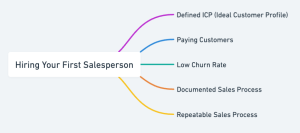
- Ready: ICP Defined, paying customers (more required for SMB, less required for Enterprise), reasonable amount of churn, consistent sales process, cold outreach has led to customers, understanding of objections and how to overcome them.
- Do you know what your ideal customer profile is? If not, you’re going to send your salesperson down a lot of rabbit holes. They’ll waste time and burn cash. Check out this article on ICP in Sales for more info.
- Do you have paying customers? If you don’t, do not expect your first sales rep to get them. They might be able to, but they probably won’t do well. It’s going to be expensive, and you’ll almost certainly miss out on all the benefits of talking to prospects from a founder’s perspective.
- How many paying customers do you have? There’s no exact number, but it’s going to be related to your sales cycle length and deal size. If you sell to SMB and have short sales cycles (under a month), you probably want at least 15-20, if not more. Enterprise sales can take a long time, so if you’ve closed a few, it may be time to consider hiring your first rep.
- What’s your churn? If you have a high rate of churn, there’s no point in bringing on a salesperson. Try to figure out what is causing the churn first and see if it’s solvable. If you can sign clients, you’re doing something right and may be in a position to hire your first rep once you’ve plugged the leaky bucket. Otherwise, you’re going to bring on clients and lose them. Not a recipe for success.
- Is there a consistent sales process? Are you able to predictably move from lead to close on a consistent basis and get clients? If so, you’re in a good position to hire that first rep. This is important because you will ramp your new hire more quickly and reduce the risk of them having to figure it out. The process may evolve, but they won’t be going in blind. Document everything.
- How are you getting customers? Being able to acquire customers via cold outreach is a stronger validation for your product and sales process than inbound leads. Inbound leads are great, but they may not be something you can always rely on. If they dry up, you could be screwed. And you may not be able to effectively convert your ICP on a regular basis via marketing so being able to crack cold outreach is key. If you’ve worked your network or had friends sign up who make up most of your customers, that’s a sign you’re not ready to hire your first salesperson. Here are cold email tips to help you book more meetings.
Can You Afford to Hire Your First Salesperson?
Good salespeople make good money. An accomplished enterprise account executive can expect a base salary in the $120-150K range plus commission/bonus. Total compensation could be in the $240-300K range. If they beat their number, it’s not unheard of for salespeople to make $400K-$750K at the enterprise level.
Mid-market salespeople can make a little below their enterprise counterparts, but they’re still paid well. OTE can be in the $150-$250K range with similar base/commission splits as above. SMB reps make the least, and will top out usually around $150K OTE, with a $100-150K OTE range. OTE = On target earnings.
Those are ballpark compensation ranges. This doesn’t include any stock they may receive. It’s important to keep in mind that good talent costs money, and these are the estimated rates you might be competing with if you’re considering a quality hire with options.
For an early-stage startup, it’s tough to compete on salary and commission alone. It’s hard for you to beat what the Series D startup with $100 million in the bank is offering.
What Does A First Sales Hire Cost For A Startup?
To the point, a good first sales hire is going to cost at a minimum of $75,000 in base salary a year. This is someone who has at least one year of closing experience, ideally two, and another year of SDR experience.
This would work for SMB and Mid-Market sales. If you have an enterprise product and can only sell large deals to enterprise clients with sales cycles in the 6-12 month range, it will be challenging and risky to hire someone under a $100K base salary.
If they accept a base salary for under 100K and have enterprise sales experience, that would raise an eyebrow.
Remember, you have to include costs like CRM seats, sales tools such as Apollo or one of these SalesLoft Competitors.
Who to Hire First
The most common mistake at this stage is hiring a VP of Sales or a senior sales leader when what the company actually needs is someone who can close.
A VP of Sales who has spent the last five years managing a team of twenty AEs with a full SDR function, a RevOps team, and a mature enablement program is not equipped to be the first person selling your product. They’ll spend the first quarter asking for things that don’t exist, and the next two quarters underperforming because the infrastructure they relied on isn’t there. This hire is also significantly more expensive than what most early-stage companies can justify when the sales function is still being figured out.
The first sales hire at most companies should be an individual contributor who can close without a lot of support. Specifically, someone who has been the first or second AE at a comparable-stage company before. They know what it feels like to sell a product nobody has heard of. They’ve built a pipeline without a BDR team. They’ve closed deals without a case study library. They give feedback on what’s working in the pitch rather than just executing it.
This is a very specific profile. Finding it requires being deliberate about what you’re screening for.
What To Look For In Your First Sales Hire
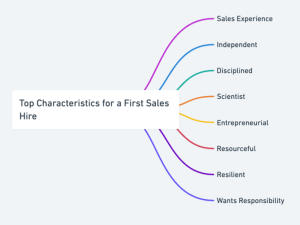
Some Sales Experience is Required When Hiring Your First Salesperson
Ideally, your first sales rep has done this before. If they have experience at early-stage startups as the first sales hire, with a verifiable and successful track record, they’re going to be an above-average fit.
Most recruiters will tell you that it’s hard to find someone who has had success as the first sales hire and wants to do it again. That’s because it’s a hard job that’s usually not fairly compensated.
It’s a bit of a unicorn hire to find someone who has done well as the first sales rep and is open to being sales employee #1 for another startup.
Specific Sales Experience
It’s unlikely you’ll find someone who is going to do this again, so look for someone who has at least two years of relevant sales experience in a closing role. That means they run the sales cycle, and the title is usually “Account Executive.“
They also need another year of SDR work. SDRs book meetings and do cold outreach. This includes cold calling and cold emailing. Ideally, as an Account Executive, they are sourcing most or all of their opportunities themselves.
You need someone who considers themselves a hunter. Industry expertise is a nice-to-have, but not a requirement. Finding someone who has run similar types of sales cycles is going to reduce your risk.
Independent
Look for salespeople who are able to work independently. If they need to constantly rely on you for answers and require a lot of support, it’s not going to work out.
“The Lone Wolf” is a type of salesperson who flouts the company rules and does things on their own. This is a top-performing salesperson persona, but is not the best persona for building teams with because they don’t like structure.
This is good for early-stage startups because you probably don’t have many rules for them to follow. They’ll figure it out.
Disciplined
Good salespeople are disciplined. Disciplined salespeople get work done. That’s important because sales is a numbers game. If you have to babysit them, you’re in trouble.
Scientist
Find someone who likes to experiment. Early on, you have a good idea what is working, but things change, and you still want to run experiments to find out what works and what doesn’t. You want someone who will be creative because that can unlock new opportunities.
There are some salespeople who like to be dropped into a defined process and execute on it. These people make terrible early hires but good later-stage hires once things are clearly established and you need to scale.
Entrepreneurial
If you can find your first sales hire who is entrepreneurial, this can not only be a way to sell them on your company, but is also an indication that they take initiative to transform things from nothing to something.
Must Be Resourceful
Your first sales hire needs to be resourceful. Large companies have a ton of resources. They have tools, training, managers, etc. Early-stage startups will have some tools, and that’s about it. The first rep needs to be able to do a lot with a little. And they need to be able to figure things out on their own.
This means if they’re not reading sales books and listening to podcasts that make them better, don’t hire them. Your first sales hire is going to be neglected by the company from a personal development standpoint. It’s normal. Startups can only do so much. But you need them to want to get better at their craft.
Resilient
Sales requires getting fed rejection all day long. Sales at an early-stage startup can be an above-average amount of rejection. You must screen for people who can eat rejection all day long and come back to work the next day hungry for more.
Wants A Lot Of Responsibility
First sales hires at startups are not only full-cycle Account Executives, but they’re also the SDR and their own sales manager. They are often responsible for account management, customer success, and customer service, too.
Being responsible for creating selling materials, such as a one-pager and a deck, is another responsibility they’ll need to take on. Some people love the idea of this. Some people expect other departments to supply it.
It will vary by startup, but there’s no doubt the first sales rep you hire will have a ton of responsibility. This is a selling point but you need to be careful not to take people who have tunnel vision or expect leads to be handed to them.
What To Avoid When Hiring a First Salesperson
No Sales Experience = Don’t Hire
Do not make your first sale hire someone who has no sales experience unless you’re a founder with a lot of sales experience and you have time to develop them. Even then it’s likely a bad decision.
You can consider someone with no experience if you’re selling something to SMBs that requires a high level of activity and not much else.
Skip The Brands
Do not hire someone because they worked at well-known, established companies. They are selling on easy mode, working for a company that everybody knows. That’s a much easier job than what you’re asking them.
It’s not a hard no because they worked at Salesforce and American Express, but you shouldn’t overweigh it. Usually, Founders make the mistake of hiring from pedigreed companies, but these people usually don’t work out.
Avoid Category Leaders
Salespeople who worked at companies that were clear category leaders are similar to people who worked at well-known companies. Don’t overweigh their success because they had it easy. They may be able to do the job, but they must check off a lot of other boxes to be considered a first sales hire.
They were selling a product that people know, want, and consider better than the competition. Your product is unknown in the category, likely lacking features, and requires selling to early adopters and innovators.
Too Senior
Salespeople who are too senior or have been at one company for too long should be excluded from consideration when hiring a first salesperson. It will be hard to recruit them as a first hire from a compensation standpoint, so you’re probably wasting your time.
More importantly, they’re likely out of touch with what is required to get the job done at an early-stage startup. They’ve mastered their way of selling their product and can do it in their sleep.
It’s possible they have a top territory or have been coasting with a manager who likes them. If they’ve been at the same company for 5+ years, they have selling habits that won’t easily transfer to a new startup.
Out of The Game
Salespeople who haven’t sold in a while should be avoided when it comes to hiring the first salesperson. A common mistake made by startup founders is to hire a former VP of Sales or Director to be the first sales hire. A founder promises them they’ll be responsible for the sales department in a few months and will be hiring some junior reps to manage soon.
What happens is the senior sales leader hasn’t been in the trenches in a long time and doesn’t have what it takes to get the job done. The pay cut is too much; they see the writing on the wall, and you’ve just wasted a lot of money and time. They often overpromise and underdeliver.
Never Trust The Rolodex
Don’t hire based on their rolodex. Rolodexes are worthless after a month. And they’re usually exaggerated. If you come across someone who claims to have a strong network that they’ll be able to quickly tap into.
Offer them a referral fee paid on signing any clients before you consider hiring them. For the most part, Rolodexes are low value when it comes to hiring your first salesperson.
What the First Salesperson’s Job Actually Is
Being explicit about this before you post the job saves a lot of time in the process.
The first salesperson’s job is to close deals, yes. But it is also to refine the pitch through repetition, to identify patterns in what converts and what doesn’t, to give the founder honest feedback on where the product is falling short in a sales context, and to begin building the foundation that the next two or three hires will run on.
That last part matters because it shapes who you’re looking for. A candidate who only knows how to execute a playbook designed by someone else is not the right fit. You need someone who can build a playbook while running it. Those candidates exist, but they’re not the same population as strong AEs at larger companies.
Setting Your First Salesperson Up to Succeed
The hire is only half the problem. What happens in the first 90 days determines whether the investment works.
Before the salesperson starts, have ready: a documented version of your sales process as you understand it, even if it’s rough; a list of target accounts with some initial research; access to your CRM and any existing contact data; a competitive landscape summary; and a list of the three to five most common objections you’ve encountered in founder-led sales, with the answers that have worked.
None of this needs to be polished. It needs to exist because starting from nothing is significantly harder than starting from a rough draft.
In the first month, the salesperson should be listening to recorded calls, shadowing the founder in customer meetings, running their own discovery calls with the founder observing, and building their initial account list. The goal of month one is deep product and market context, not pipeline.
In the second month, they should own their own pipeline entirely. The founder steps back from calls except when their presence genuinely adds value — a specific technical question, a strategic relationship or a deal that requires founder-level commitment. Weekly one-on-ones focus on specific deals and the blockers to them.
By the third month, you have real data. Pipeline created, meetings booked, deals progressing, first closes or near-closes. This is the point at which the hire either shows the signals of working or reveals problems that need to be addressed. Three months is not enough to judge definitively, but it is enough to see whether the trajectory is heading in the right direction.
When to Hire the Second Salesperson
The second sales hire should come from a fundamentally different trigger than the first. The first hire was about testing whether someone other than the founder could sell the product. The second hire is about scaling something that’s been validated.
Before you hire the second AE, you should be able to answer two questions with evidence. First: Is the first AE producing consistently enough that the bottleneck is now capacity rather than process? Second: Do you have enough pipeline coming in to keep a second AE productive?
If the first AE is inconsistent or the pipeline is thin, hiring a second AE multiplies the problem rather than solving it. The second hire often makes more sense as an SDR who builds the pipeline for the first AE, or as a sales manager if the team is ready for that layer.
How To Hire A Salesperson For Your Startup
Hiring your first salesperson is a major hire milestone. Founders need to be careful not to get tricked by the pedigree, rolodex, and slick-talking salesperson who has been killing their quota at a category leader.
They need to find a lone wolf type who can figure things out because they’re resourceful. When it comes to hiring the first salesperson, you need to make sure you’re ready as a startup.
It’s a hire you should not rush because you don’t like sales. Take your time to find the right person. The first salesperson at a startup is the Founder. Make sure you’ve built a repeatable process and can document what you’ve done to close deals.
If you’ve done this, not only will you be able to attract better talent, but when it comes to hiring the first salesperson, they’ll be more likely to succeed.
First Sales Hire Red Flags Checklist
Use this during your interview process. These are signals worth taking seriously — not automatic disqualifiers, but patterns that warrant a harder look.
- Can’t describe a specific deal they closed end-to-end, including the objections
- Talks about what their team accomplished, not what they did personally
- References inbound lead volume as a key factor in their past success
- Has never sold a product without brand recognition behind it
- Immediately asks about marketing support, SDR coverage, or collateral before asking about the customer
- Hasn’t researched your product or market before the first call
- Claims their network will close deals in the first 60 days
- Has been at the same established company for five or more years
- Asks for a comp package that doesn’t include meaningful equity consideration
- Deflects when asked what they would have done differently on a deal they lost
What to Pay Your First Sales Hire
Compensation for first sales hires varies by stage, role type, and how much of the offer is cash versus equity. These figures reflect 2026 market rates for Series A and early Series B companies.
| Role | Base Salary | OTE | Equity (typical options) |
|---|---|---|---|
| First AE (Series A) | $70K to $95K | $120K to $175K | 0.1% to 0.5% |
| First AE (Series B) | $80K to $110K | $140K to $210K | 0.05% to 0.2% |
| First SDR | $48K to $65K | $68K to $95K | Options common at seed and Series A |
| First Sales Manager or Head of Sales | $100K to $140K | $160K to $240K | 0.2% to 0.5% |
Equity is a meaningful part of the first sales hire conversation at early-stage companies. A strong candidate choosing between your Series A offer and a safer, higher-cash offer at a Series C company is doing a risk-reward calculation. How you tell the equity story matters as much as the numbers. Be specific: what is the company worth now, what does the option grant represent at current valuation, and what does a realistic exit scenario look like? Candidates who’ve done this before know how to evaluate it. Vague equity upside language does not move them.
One consistent pattern: founders who try to compete purely on cash with later-stage companies for the same candidates usually lose. The candidates worth having at your stage understand what they’re trading and are choosing it for reasons that go beyond comp — belief in the product, the market, the upside, or the chance to build something. Finding those candidates is a different search than finding the highest-paid AE at a mature company.
How to Structure the Interview Process
A first salesperson interview process that only tests for likability and communication skills is not predictive. Those are necessary qualities. They are not sufficient.
Round one: screening call (20 to 30 minutes). Cover the basics. Why this role, why now, what they know about your product and market. You’re filtering for preparation, communication quality, and genuine interest. A candidate who hasn’t researched your company before a first call is showing you how they approach new accounts.
Round two: structured interview (45 to 60 minutes). Go deeper on substance. Ask about specific deals they’ve closed — what the ICP was, what the sales cycle looked like, what objections came up and how they handled them, what they wish they’d done differently. Ask about a time they failed to close something they expected to win and what they learned. The quality of the reflection tells you as much as the outcome.
Ask specifically about their experience at early-stage companies. What did the sales motion look like when they joined? How did it change while they were there? What did they build versus inherit? These questions distinguish candidates who’ve been in a startup environment from those who are describing it based on what the job description said.
Round three: work sample. Give them a realistic task. Write a cold email to a target persona for your product. Prepare a 10-minute pitch as if you were a prospect. Run a brief mock discovery call where you play the buyer. The gap between how candidates describe their sales approach and how they actually execute it is often significant. The work sample closes that gap.
Round four: reference calls. For a first sales hire, reference calls are non-negotiable. Talk to a former manager and a former peer. Ask about performance specifically — quota attainment, ramp time and how they handled adversity. Ask whether the reference would hire this person again and why.
First Salesperson Interview Scorecard
Use this to evaluate candidates consistently across rounds. Score each dimension 1–4 (1 = weak signal, 4 = strong signal).
| Dimension | What You’re Evaluating | Score (1–4) |
|---|---|---|
| Early-stage fit | Has sold at a startup before; comfortable with ambiguity | |
| Pipeline ownership | Sources own deals; doesn’t rely on inbound or SDR handoffs | |
| Process thinking | Can articulate a repeatable approach; willing to iterate | |
| Objection fluency | Handles pushback naturally; doesn’t deflect or over-explain | |
| Product curiosity | Asks smart questions about what you’re building and why | |
| Coachability | Reflects honestly on losses; doesn’t over-attribute to external factors | |
| Work sample quality | Cold email / pitch / discovery call shows real-world execution skill | |
| Reference quality | Former manager gives specific, positive answers; would rehire |
Scoring guide:
- 28–32: Strong hire signal. Move fast.
- 20–27: Promising. Identify the gaps and decide if they’re coachable.
- Below 20: Proceed with caution or pass.
The Mistakes That Sink First Sales Hires
Hiring someone from a brand-name company because the brand feels validating. A top performer at Salesforce or HubSpot had inbound leads, a recognized brand, a mature process, and institutional sales support. That environment is not yours. The skills that made them successful there may not transfer to selling an unknown product in a market that isn’t waiting for you.
Skipping the work sample. Sales is a performance role. You would not hire an engineer without seeing code. Do not hire a salesperson without seeing them sell something.
Giving a short runway before judging the hire. First sales hires at early-stage companies need 90 to 120 days before their performance is meaningful data. The first month is product learning. The second is pipeline building. The third is where you start to see real signals. Judging at 45 days is almost always premature.
Not setting metrics clearly from day one. A salesperson who doesn’t know how they’ll be measured will optimize for activity that looks productive rather than outcomes that matter. Define what success looks like in the first 30, 60, and 90 days before they start, not after.
Over-managing or under-managing. Founders often swing between these extremes. They either stay too involved because they’re anxious about the hire, which undermines the rep’s autonomy and signals distrust. Or they step back completely and leave the rep without the product context and founder-level insight they actually need to sell effectively. The right cadence is a weekly one-on-one focused on deals, a monthly review of pipeline quality and metrics, and availability for customer calls where the founder’s presence adds real value.
Ready to Make Your First Sales Hire?
RevPilots works with early-stage founders to define the role clearly, identify the right candidate profile, and run a search that produces the specific type of first sales hire that performs in a startup environment, not a generic AE who looks good on paper.
We’ve placed first sales hires at seed, Series A, and Series B companies across SaaS, fintech, cybersecurity, and other B2B categories — and we deliver qualified candidates within 5 days of intake.
RevPilots Helps Founders Get This Hire Right
Hiring your first salesperson is a decision that shapes the next two years of your company’s trajectory. Most founders do it without a clear framework, without the right screening criteria, and under time pressure that makes careful evaluation hard.
RevPilots works with early-stage founders to define the role clearly, identify the right candidate profile, and run a search that produces the specific type of first sales hire that performs in a startup environment — not a generic AE who looks good on paper. We have placed first sales hires at seed, Series A, and Series B companies across SaaS, fintech, cybersecurity, and other B2B categories, and we deliver qualified candidates within 5 days of intake.
Talk to RevPilots about your first sales hire
Additional Reading:
- SDR Outsourcing
- Hiring an Outsourced BDR
- Fractional SDR
- Hiring an SDR
- Sales Management Outsourcing
- Fractional Sales Management
- Sales Outsourcing
- SDR Outsourcing
- Fractional CRO
- Fractional VP of Sales
- B2B Sales Consulting
- Fractional COO
- Sales Coach
- How to Hire a Sales Manager
- Hiring your first SDR
- SDR Recruiting
Frequently Asked Questions On Hiring Your First Salesperson
When should a startup hire its first salesperson?
When the founder has enough evidence of what converts, so that someone else could execute it, typically after five to fifteen customers have been acquired through a documented process. Hiring before that usually means the first salesperson is doing product discovery while selling, making it nearly impossible to accurately evaluate their performance.
Should the first hire be an AE or a VP of Sales?
Almost always an AE. A VP who has only managed large, mature sales teams is not equipped to be the first person selling an early-stage product. The right first hire is an individual contributor who can close without much infrastructure — ideally someone who has been the first or second AE at a comparable stage company before.
How much should I pay my first salesperson?
For a first AE at a Series A company in 2026, expect a $70,000 to $95,000 base salary with an OTE between $120,000 and $175,000. Equity is a meaningful part of the package at this stage, typically 0.1% to 0.5% in options.
How long does it take a first salesperson to ramp?
At an early-stage company with a defined ICP and some process documentation, 90 to 120 days to full productivity is realistic. Without those foundations, the ramp takes longer, even with a strong hire. The quality of the first 30 days has more impact on ramp time than almost anything else.
What should I look for when hiring a first salesperson?
Prioritize candidates who have sold in an early-stage environment before — ideally as a first or second AE at a comparable-stage company. They should be comfortable building a process rather than executing one, willing to give honest feedback on the pitch, and capable of closing without a BDR team or full enablement support.
When should I hire a second salesperson?
When the first AE is producing consistently, and the bottleneck is capacity rather than process, and when there is enough inbound pipeline to keep a second AE productive. If the pipeline is thin or the first AE is still inconsistent, a second AE multiplies the problem. Often, the right second hire is an SDR to build a pipeline for the first AE.